Monday, May 7, 2018


You know, sometimes, you just have those weeks. 

You know the ones. When anything that comes out of your mouth is an awkward stutter. When you break a shadow box at work and need to spend the money you were saving for a book shopping spree to replace it. When it rains so hard that there’s a puddle of water in your car that you have to mop up. When you’re on your way to chill at a cafe while you work you straight up step in cement, and the lady waiting to turn left at the stop sign judges you while you use the wet grass around you to try to save your favorite pair of chuckies. When it’s only Thursday, you’ve already filled your adventure quota, you’re still grieving after watching Infinity War, and you still have half the week left to live.


So you take a breath.

You realize that, realistically, most of the people you serve at your job have already forgotten your face by time they walk out the door. Shadow boxes come and go, but books will always be there. You need to fix the leak in your car, dummy. Your favorite chuckies were breathing their last before they got caked in sidewalk pudding. And, worry not, there will be an Infinity War II.


Besides, 

You’ve sold a story. That’s pretty baller. And you’re prepping to take The Monster Mystery to the Writer’s Digest conference in New York come August. You got back on the treadmill this week, and ya did pretty good kid. You’re going to pass out food to the homeless tonight and spend sometime with your squad at Navy Pier. Also, frick mate, this roasted almond tea tastes pretty good. Roasted Almond. What a concept.
You could do better, sure. But you could also do a heck of a lot worse. 

‘Til next time, nerds.


P.S. The Glenview Grind is charming as frick. People here are actually nice. The guy that sat to my left offered to move his stuff and unplug his laptop. The one to my right trusted me to watch his stuff. What a world.

Tuesday, May 1, 2018


*cracks knuckles*
Let’s do this. 

As an aspiring writer with a following that is still a work in progress get off my baCK ‘KAY HERMONO? I’M WORKING ON IT, I do not have a lot going on in the writing sense. Outside of my part time job, the projects I’m pounding out are barely anything compared to the work load of a profession. But it warrants exploring what kind of time and effort that takes. So I’m going to break it down by the most exciting metric I can think of. Numbers. 
*Skip to the last few paragraphs for The Point (TM). 

THE MONSTER MYSTERY
THE BOOK CURRENTLY OUT FOR SUBMISSION
As the title suggests, the active narrative work on this sucker is done for now. It is awaiting an offer, Lord willin’ and the creek don’t rise. So right now the focus is on market research and submission. We’re in Query Land folks, the least successful amusement park since 63% of Wisconsin. (Not just the water parks, mind you. Wisconsin as a whole.) This project took 2 years to get to in submittable-shape, most of that period spent splitting my focus between it and school work. 

DRAFTING: 6 months
EDITING: 1.5 Years
DRAFTS: 3
SUBMITTING: Ongoing
SUBMITTED: 23
REJECTED: 7
IGNORED: 2 (probably. Who knows. This business is slow.)
FEELINGS HURT: Exactly 4

THE NIGHTMARE THRILLER
STILL IN PRE-PRODUCTION
I’m still in the process of putting all the pieces together. This includes a lot of reading, interviewing, journaling, conceptualizing, so on and so forth. Turns out, dreams are tricky. Trying to nail down exactly how to write them, along with figuring out how to handle the overflowing Controversial Material (TM) that keeps on popping up in the book is-hang on, let me check my notes-
*knocks down tower of papers on desk
*shuffles through mess on floor and plucks a single sheet of paper
*squints at paper
-hard.

RESEARCH & DRAFTING: 4 Months and still ongoing

THE SHORT STORIES
Here, at least, I can offer you lovely readers some conclusive data. Not all that much, however, because that’d just be too much fun. To give some context, writing and sending out short stories is like the lite version of sending out a novel. Doesn’t take as long to write them, you skip the middle man, don’t have to do as much research on your markets, and sometimes don’t have to wait as long for a reply. Yet, somehow, rejection still packs the same punch. 
ANYHOO. 

Mr. Pascal’s Funeral Parlor - 1 Month
WRITTEN: 1 week. Back in high school. 
DRAFTS: 1 
SUBMITTED: 1
ACCEPTED: 1
*don’t ask me how I did this. I don’t know how I did this. I haven’t been able to do this again.
The Great Oak of Hypothetical Nowhere - Submission Ongoing
WRITTEN: 1 month
DRAFTS: 3
SUBMITTING: On Hiatus. Like Twenty One Pilots
SUBMITTED: 9 
REJECTED: 9
PRIDE: HA. Itsfine. 
Siren - 3 Months
WRITTEN: 1 week
DRAFTS: 2
SUBMITTED: 4
REJECTED: 3
ACCEPTED: HECK YEAH BABY. NON-PAYING SCHOOL MAGAZINE STILL COUNTS. 
Jack vs. The Bloody Carpet - 2 Years
WRITTEN: 3 weeks
DRAFTS: 2.5
SUBMITTED: 19
REJECTED: 15
IGNORED: 1
ACCEPTED: FRICK. YES. 
Ann - 5 Months
WRITTEN: 1 month
DRAFTS: 6 
SUBMITTED: 4
REJECTED: 3
ACCEPTED:
 Image result for gif victory
Quesadillas of Questionable Origin - Submission Ongoing
WRITTEN: 1 afternoon
DRAFTS: 2
SUBMITTING: Ongoing 
SUBMITTED: 3
REJECTED: 3
PRIDE: Could be worse. I’m not dead. That counts for something, right?

ONGOING PROJECTS
Here’s a look into the workshop, all the things that could come to be. Clock them in at about 800-1800 words a piece, meaning they take a good afternoon to write if the juices are flowing. 

*Linda and the Chosen One’s Ring - Short Story - Submission Prep
*Dragon in the Hearth - Short Story - Draft 2
*A Change of Pace - Graphic Short - Draft 1
*God and the Process of Grief: A character study of A Monster Calls - Article - Pitched
*Piracy and Intellectual Property - Blog - Researching/Drafting
*Letting Your Writing Be Cheesy - Blog - Outlining
*Christianity’s Relationship with Art - Blog - Researching
*Improving Zelda: Breath of the Wild’s Ending - Video Essay - Written ALL THE WAY BACK IN 1965 WHEN MILK WAS A NICKEL, CHURCHES WERE FULL ON SUNDAY MORNIN’S, AND THE MOTOZOLA RAZOR WAS STILL A COOL PHONE.
Ahem. 
Videos are hard.

So there it is. That’s the stuff I have recorded. Not an exhaustive list by any means but it’s a start. Not counting the stuff I tried to send out before college or the comic I tried to self-publish once upon a time because that is another post altogether.
Why am I sharing this with you? Because you ought to know that even in the barest of efforts, even when you distill it down to just the numbers, writing takes. It takes time. It takes effort. It takes guts. It takes heart. Put all the mushy starving artist nobody-respects-ART-man sentiments in a drawer and you’ve got a career that demands you sacrifice your evenings, weekends, days off, whatever you have feed the machine. And it won’t sustain you until the planets align in your favor. It’s a crazy business, mate. You gotta be crazy to be in it. 


Thursday, April 12, 2018


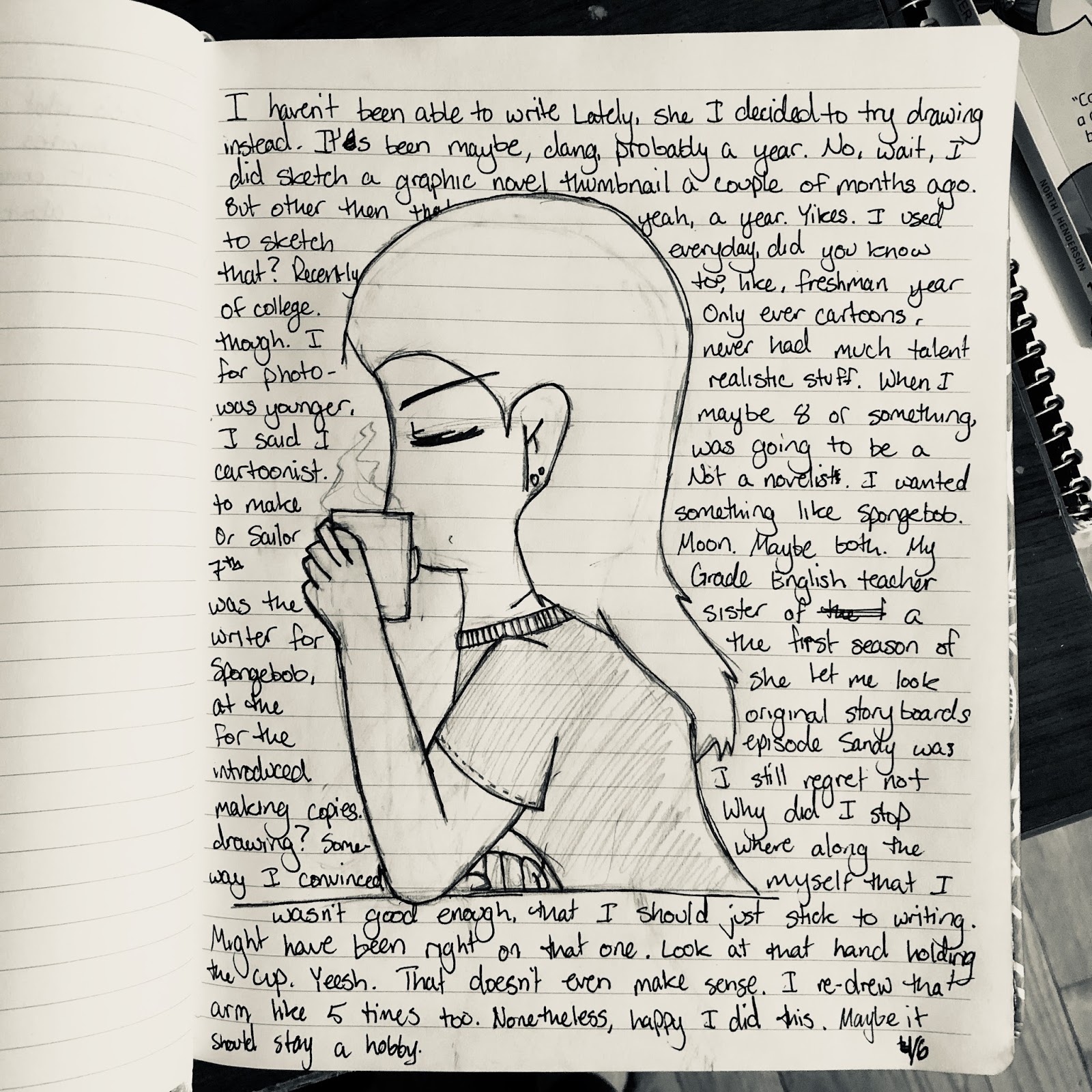
I haven't been able to write lately. [Got a lot on my mind.] [So] I decided to try drawing instead. It's been maybe, dang, probably a year. No, wait, I did a sketch of a graphic novel thumbnail a [few] months ago.  But other than that, yeah, a year. Yikes. I used to sketch every day, did you know that? Recently, too. Like, freshman year of college. I only ever [drew] cartoons, though. Never have much talent for photo realism. [I still have a pile of sketchbooks lying next to my desk.]

When I was younger, I said I was going to be a cartoonist. Not a novelist. I wanted to make something like Spongebob. Or Sailor Moon. [Frick it,] maybe both. My 7th grade teacher was the sister of a writer for the first season of Spongebob. She let me look at the original storyboards for the episode Sandy was introduced. I still regret not making copies.

Why did I stop drawing? Somewhere along the way [I guess] I convinced myself that I wasn't good enough, that I should just stick to writing. Might have been right on that one. Look at that hand, [the one] holding the cup. Yeesh. That doesn't even make sense. I re-drew that arm-like, 5 times too. Nonetheless, happy I did this. Maybe it should stay a hobby.


Wednesday, March 7, 2018


     Recently, The Plan was derailed. It was all set in motion, everything was running smoothly. And then it wasn't, and that affected me a little more then I'd care to admit.
     For context, The Plan was simple.
     -Graduate.
     -Have a full time job waiting after graduation.
     -Send out The Novel.
     -Have a deal by the end of 2018.
     -Vlog twice a month.
     -Blog twice a month.
     -Be better at social media.
     On paper, seems easy enough. In practice, harder. Much harder. Yet, somehow, I managed. At first. I got a job as a survey caller that paid pretty nice. Enough to make a living. And, the whole “being a writer” thing was working out, too. I still have a back log of scripts ready for filming and posting, plus half a dozen concepts waiting on my hard drive. For about two weeks, things were looking A-O-K.
     But, this wouldn’t be a good story unless things went wrong. So, don’t worry, your friendly neighborhood unsuspecting protagonist is about to have a Bad Time.
     Two days after my last class I got rear ended on a highway and ended up with a concussion to show for it. Getting a concussion, as it turns out, is like being forced to take a vacation that you're not allowed to have fun at. That story again, it's like taking a vacation with your family. A week later I was working two jobs, ending one while starting the other at the same time. Leaving the old one broke my heart to bits and the new one did not turn out great. The experience is something is not something I'd like to rehash, so suffice to say it was the worst. After three weeks I had a mental breakdown in the middle of my shift. I left soon after.
     The month I spent after that without a job was rough. Life had stopped for me. I went from nine hour work days to having nothing to do. Looking at things practically, this was a great opportunity to focus on what I wanted too. I had all the time in the world to work on my career.
     But I couldn’t.
     The Plan not working out was a failure. It completely stopped my momentum. It paralyzed me. Staring at a blank page had never been so painful. The Goal, writing for a living, seemed farther than ever.
     Eventually I had to force myself to write anything, even if I knew it was bad. And now it’s come to this. Personal narrative. My least favorite genre to write.
     Here’s what I’m trying to say. I haven’t been able to sit down and have a properly productive day since I quit my job. I’ve barely finished writing a first draft of a short story, sent out a pitiful amount of queries, haven’t filmed a g*sh d*ng thing. Right now my self confidence is nonexistent and thinking about the future terrifies me. I. Am. Lost.
     The easiest thing to do would be to hate my life right now. But if I can’t be satisfied even when things don’t go my way, life will torture me.
     What God is teaching me right now (probably not for the first time, if I’m being honest) is to be content. And, if I’m getting this right, being content is all about being satisfied with where I am. Not by what I’ve already done, not by what the future might hold. But right now, sitting cross legged on my couch, trying to convince myself I can finish reading an 800 page novel and watch a 37 part lets-play at the same time. I don’t need to be happy or sad about it. I just need to accept that this is where I am.
     So, The Plan was derailed. I’ll live.


Thursday, February 22, 2018


I like books. I like 'em Christian, and I like 'em otherwise. But, I’ll be the first to admit Christian literature has a reputation for being sub-par, for sacrificing the story for the message. And, after thinking about it, I have to agree. For the most part. But then, if I was asked the same question about mainstream genre or YA, I’d say the same thing. Mainstream trends exist in every corner of art and the ability to rise above these trends is where you find truly good work. Having all that said, today I’m picking on my squad.

So, Christian fiction writers, let’s talk endings. 

The ending is crucial, it has the potential to ruin a story. In the most general sense stories end up concluding in one of three way.
     1) The ending can either be satisfying, leaving all the most important lose ends tied up and all of the characters with what they deserve.
     2) It can be haunting, not answering all the questions presented in the narrative and daring the reader to draw their own conclusion.
     3) It can completely undermine the stakes, voiding the purpose of the narrative.

The last outcome is obviously the one that storytellers want to avoid, and unfortunately it is the one that most Christian storytellers fall into all too easily. Every storyteller cares about the characters in their tales, we're all inclined to lend them a hand. And, as Christians, I think we indulge a little too much in the “Jesus saves the day” sentiment. I mean, Jesus does save the day, just not always in the walk-off-into-the-sunset way we might want Him too. Sometimes, God’s perfect resolution doesn’t look even a little bit like a happy ending to us, and this is something sorely lacking in Christian storytelling.

Whether it's because we care too much or because we think happy endings should always end with the dragon being slain and the prince and princess living happily ever after, we set ourselves on a superficial path of satisfaction. When Christians resolve a story, our focus tends to lie more on justifying the events that occurred in the book rather than allowing the consequences to come. Let me unpack that by talking about the difference between happy endings and good endings, both done in fiction with Christian themes.

Also, should let you know that we're wading into *SPOLIER* territory for Lord of the Rings and The Visitation by Frank Perettii. I’m not going to recap the Lord of the Rings, if you haven’t read it or seen the movies by now then you just don’t care. Go read the wiki and come back when your done.

*the "Protagonist" making a Poor Choice (TM)
From Frodo’s point of view, the Lord of the Rings had a good ending without a traditional “happily ever after”. And that is because at the very end of the story, Frodo fails. He doesn’t willingly cast the ring into the volcano, as he was charged to do. This is where we deviate from a common place ending, in a general plot progression the protag is allowed as many mistakes as they want as long as the conclusion of the story is that they learn from and overcome them. We see Frodo begin a downward spiral as soon as he comes into contact with Gollum. In the ending we see Tolkien stay true to this turn of events when Frodo, partly due to Gollum’s influence, succumbs to his lust for the Ring rather then overcoming it.

Because of this, in the final moments of the conflict he wasn't portrayed as the victorious hero. Were it not for the intervention of his closest friend, Sam, he would have followed the Ring into the volcano and died, just like Gollum. (And I’m a little bit of a terrible person because at that point, I kinda wanted him too.)

In the end, he paid the price. Two years after the Ring is cast into the volcano, when he boards the boat to elsewhere with Gandalf, that's a metaphor for his death. His time with the Ring had sapped away his life. (I mean, it was technically the wound he got from the Nazgul that did him in, but I’m one who likes to indulged in a good spot of poetic justice every now and then.)

Frodo doesn't get a "happy ending". He doesn't go back to his normal life in the shire. He doesn't enjoy years of friendship with Sam, doesn't settle down and start a family. The moment the ring became his burden that life, although something he yearned for, was closed off to him. And he suffers the consequences of having technically failed at the end of his journey. But the ending is satisfying. Peace has returned to middle earth because of Frodo's actions. Frodo's given the grace of at two more years in the shire. And, in the end, he sails off with best buddy Gandalf the beige to his great reward.

Because he dies. That’s what that means, guys. He’s dead. Super dead. Not going to be in Rush Hour 3. I don’t get how people don’t get that.

*boat of death.

The Visitation by Frank Perettii, has a happy ending that's not really a good ending. Since it’s lesser known, here’s the gist. The book takes the point of view of Travis Jordan, the cynical pastor of a small town church who ends up going head to head with a cult, lead by a man claiming to be the second coming of Christ. Sounds interesting, right? Well, it was. Until the end.

*A pastor.

It’s not a bad story, but the ending is…a let down. It just doesn’t deliver. You’re teased the entire book about this “dark past” that the protag has only to realize it’s not all that dark. There are a lot of developed characters that just silently fade into the background after a certain point. There’s a lot of potential for using the events that happened in the book to inspire growth in either individual characters or the town as a whole, but it didn’t. The ending literally is the bad cult guy getting defeated, the damsel in distress getting saved, and everything going back to normal. Only difference is that afterward more people end up at church. Some could argue that that is point. If it is, then that isn’t necessarily a good point to make.

The book had so much potential, so many points intrigued me. But in the end, it was all thrown away because the narrative was focused on making sure the reader knew that Jesus always wins. The ending wasn’t a result of all that had happened in the story, it was a tool for making the story end on a high note. And one thing an ending should never be is a tool.

So that brings me back to my first point. Notice that Lord of the Rings and The Visitation both have endings widely considered to be “happy”, but only one qualifies as “satisfying”. And that is largely due to the problem I mentioned at the beginning of this video. The Visitation focused on justifying the events that occurred in the book. It didn’t want to talk about reality, it wanted to tell a superhero story. Lord of the Rings, however, stayed true to what had transpired in it’s narrative and the ending felt natural because of that.

That’s all I’ve got. ‘Til next time nerds.


Wednesday, January 17, 2018


    So, college. I’m done with it now. And that’s great, because now’s the part where I get to finally pursue what I went to college for, what I’ve been dreaming of doing for most of my life. Writing. Full time. And I’m thankful that I got to go to the school which is now my alma mater, because they have a fantastic writing program. Thanks to that school, I not only have skills to refine my writing to a professional degree, but strong works vetted by industry veterans that are ready to send out. I also have experience and connections I would not have been able to get otherwise. 
    But, as I leave the land of institutionalized learning forever, I’m realizing there are things that they should have prepared me for that they really didn’t. I have my fair share of classes that I’m positive I didn’t need and courses I really wish existed. Especially now, sitting at my desk, writing this post, I’m all too aware of the things I am woefully unprepared for.
    The biggest thing that still catches me as kinda dumb is the emphasis on learning things you probably won’t otherwise use outside of a school setting at the expense of things you definitely will, especially at a level of education where you are expected to have already chosen a specific area of study. It’s safe to assume that if you want to be a film director, you don’t need a working knowledge of theoretical physics. It’s nice to have, but not necessary. But that film student needs a science credit, and it’s either that or quantum mechanics. Meanwhile, a science credit that would benefit his field of study-let’s say camera mechanics or a lab explaining how to safely execute on-set stunts-is an elective. Call me crazy, I think it should be the other way around. That said, here are a couple of things that I wish (as a writing student) would have been part of the curriculum for my core studies.

    You know what’d be nice?  A personal/freelance finances class. Make it a math credit too. 
I would have loved a crash course on how to handle finances as a freelancer, considering that most writers end up being just that. We’re essentially running small businesses, I feel like it’s important to know what exactly goes into that. And aside from running a business, college, you’ve got a bunch of students in your school deep in debt just to have the opportunity to be there, I feel like it’s in your best interest as well if you teach them the most efficient way to pay you back. That way, you can cash in on that money stuff you seem to love so very much. 
    Here’s the thing, the math credit I ended up taking was College Math. And it was a joke. It was basically a refresher of everything I learned from first to twelfth grade. No joke, I spent the first day learning how to round, add, subtract, divide, and multiply. I commonly cite it as one of the biggest wastes of my time at school and I was required to take it. Meanwhile, the closest thing I could find to anything relating to finances was an accounting class intended for Fashion Business students that I would have had to waste one of my elective credits for.

    While we’re at it, include more business and freelance classes into the main curriculum. 
    Teach me what publishing houses will expect from me, show me tricks on how to make it into the business, have me prepare presentations that I can test out in the classroom before I can take it to the world. In all of the classes I was required to take in order to graduate from my school, all I was given a brief summary on how to write a cover letter in one of them. And even at that it was something the teacher decided to just casually bring up. 
    This isn’t to say that my school didn’t offer any classes on business, they offered one freelance-specific course, and all of the professors that taught the genre courses were sure to include a business element in their classes. But the freelance-course isn’t part of the core curriculum. If your program is designed towards equipping writers with the skills to make it in the industry, this is pretty freaking essential. It should be required that every student take an industry-business related course before they graduate because that is knowledge they will use extensively.

    Also-IMPORTANT-Do not make me fill credits just to fill credits. 
    Never thought I’d say that too many electives would be a problem, but I can’t tell you how many semesters I had to pick a class that didn’t contribute to my career or any of my interests. Now, this could be a result of my bad luck with registration timing, but more than once I’ve had to consider taking Tap-dance for Non-majors just so I could graduate on time. Two semesters, I decided to go part time just so I wouldn’t waste money on courses that would not benefit me in the slightest. That is a problem, schools. A big, big problem. And I’m sure it’s not just my school that does this. 
    It’s good that an art school acts like an art school. It’s good that they put emphasis on exploring new things and going down paths that you wouldn’t otherwise consider. But when that comes at the expense of learning more practical skills, there’s a problem. Like any school, there’s a balance to be had when learning the humanities and the sciences. This one still needs a little work.